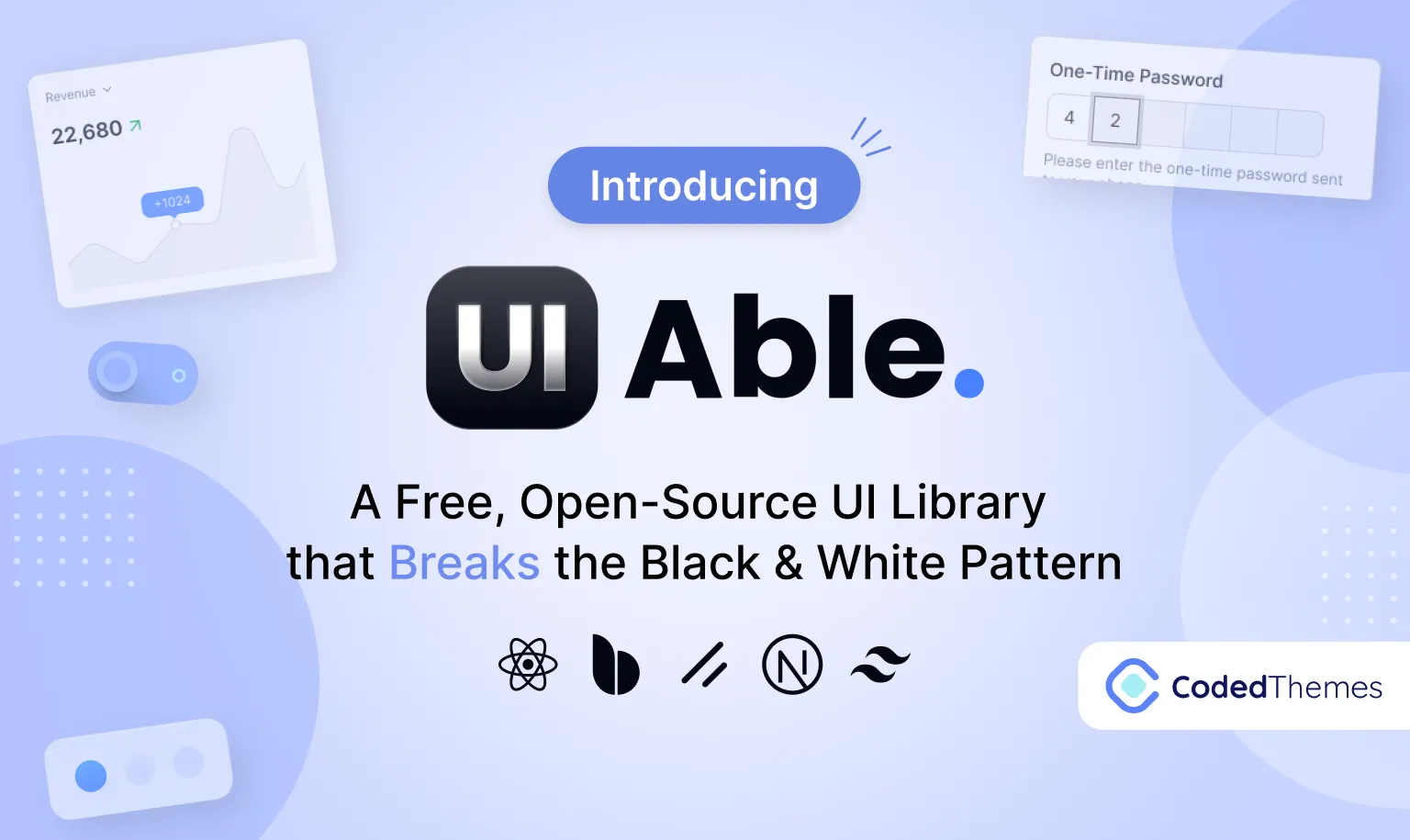
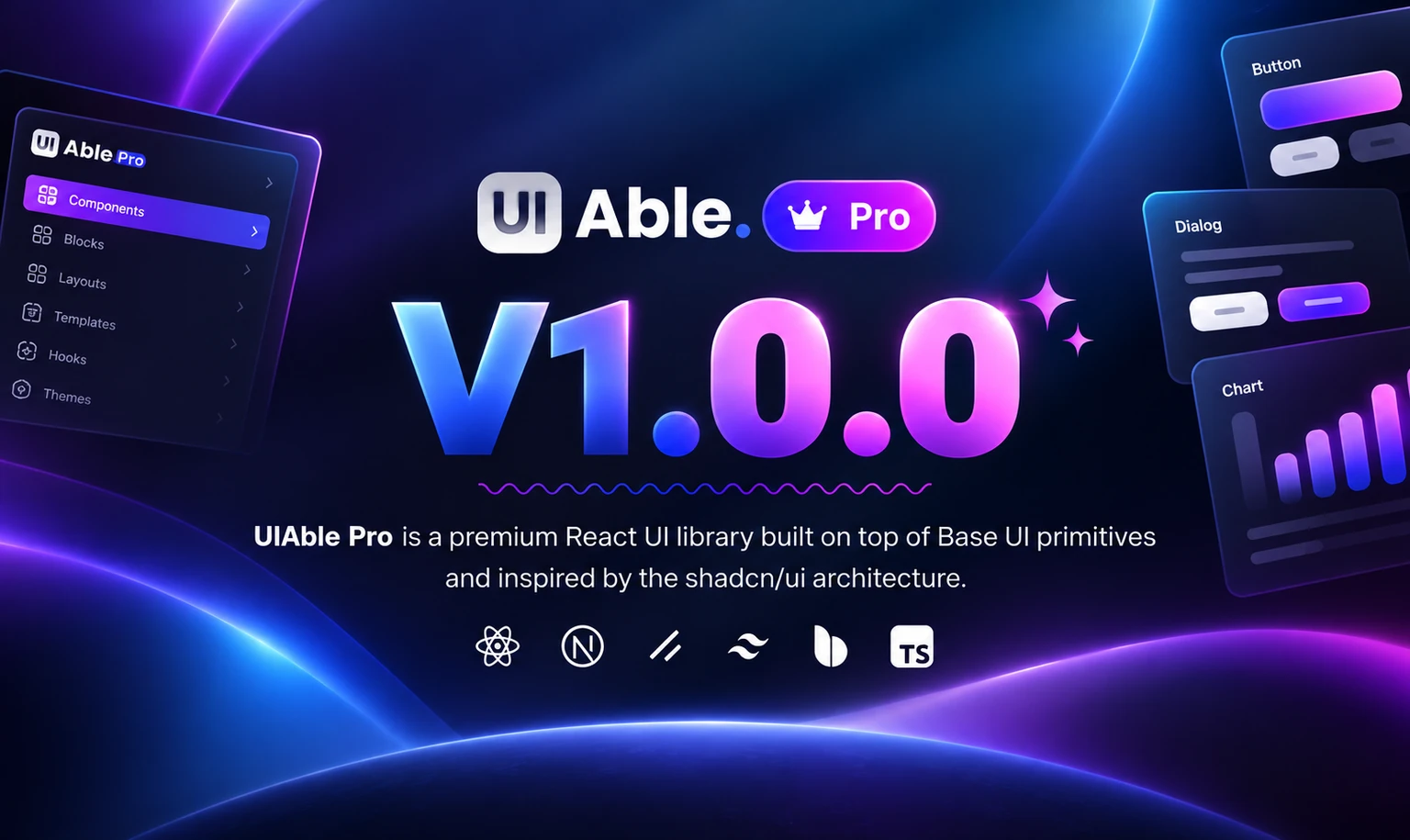
With UIAble v1.5.0, we’ve added more production-ready blocks and component variants that you can copy, customize, and ship immediately.
And yes…
Everything is still completely free and open source.
With UIAble v1.5.0, we’ve added more production-ready blocks and component variants that you can copy, customize, and ship immediately.
And yes…
Everything is still completely free and open source.
Building with a UI kit should speed up your development cycle, not slow it down.
SaasAble UI Kit comes with a rich set of production-ready React and MUI components, but turning an idea into a working feature still takes effort. Developers often spend time searching for the right components, writing custom logic, and constantly switching between their editor, browser, and documentation.
Over the past week, our focus wasn’t on building something entirely new, it was on making UIAble better. We revisited existing components, added the variants we kept reaching for ourselves, and introduced a few new UI blocks that are ready to drop into your next project.
Here’s everything that’s new in UIAble v1.3.0.
Today, we’re excited to launch UIAble v1.0.0, an open-source component library built for developers, by developers.
We explored a lot of UI libraries built on Shadcn. Most of them feel nearly identical — same structure, same aesthetic, same tradeoffs. That’s what pushed us to build something different. Not another library that looks like Shadcn with a coat of paint, but a design system with its own identity and a clearer sense of what it’s actually for.
Vuetify has always been an excellent choice for building Vue applications. However, with today’s front-end development trends leaning more towards adaptability and speed, they have created something entirely new: Vuetify Zero (Vuetify 0).
Different from conventional UI frameworks, Vuetify Zero is not concerned with pre-built UI components. It is a headless, composable framework designed to give users full control over their UI even as they base their logic and accessibility on solid ground.
Angular 22 focuses on cleanup, performance and more modern development patterns rather than new features.
If you are planning an Angular 22 upgrade for your admin dashboard then there are a few important changes you should know. Some older APIs are removed, routing behavior is slightly different and templates are now stricter which means parts of your existing code may need updates.
Building Vue applications usually means working with a UI library. You pick one like PrimeVue, install it, and start building. Everything feels good at first. You get beautiful components out of the box, import them, and move quickly.
Then reality hits. Your client wants the button to behave differently. Your design system needs a sidebar with custom spacing. A component you need simply isn’t there. So you start overriding styles, wrapping components, pulling in a second library because the first one doesn’t cover everything. Before long, the codebase is a mess.
This is the problem shadcn-vue solves.
Creating web projects today is much more complicated. Web developers do not just create pages; they develop entire web apps with dashboard interfaces, advanced forms, live updates, and custom user interfaces.
So MUI dropped v9 last week. And yes, they jumped Material UI straight from v7 to v9. There is no Material UI v8. The reason is pretty sensible. MUI X was already on v9, and they wanted to re-align the major versions across the whole ecosystem so you’re not spending 20 minutes every upgrade figuring out which version of @mui/x-data-grid pairs with which version of @mui/material.
Stay updated on upcoming Premium & Free themes, exclusive promo codes, and special sales!