
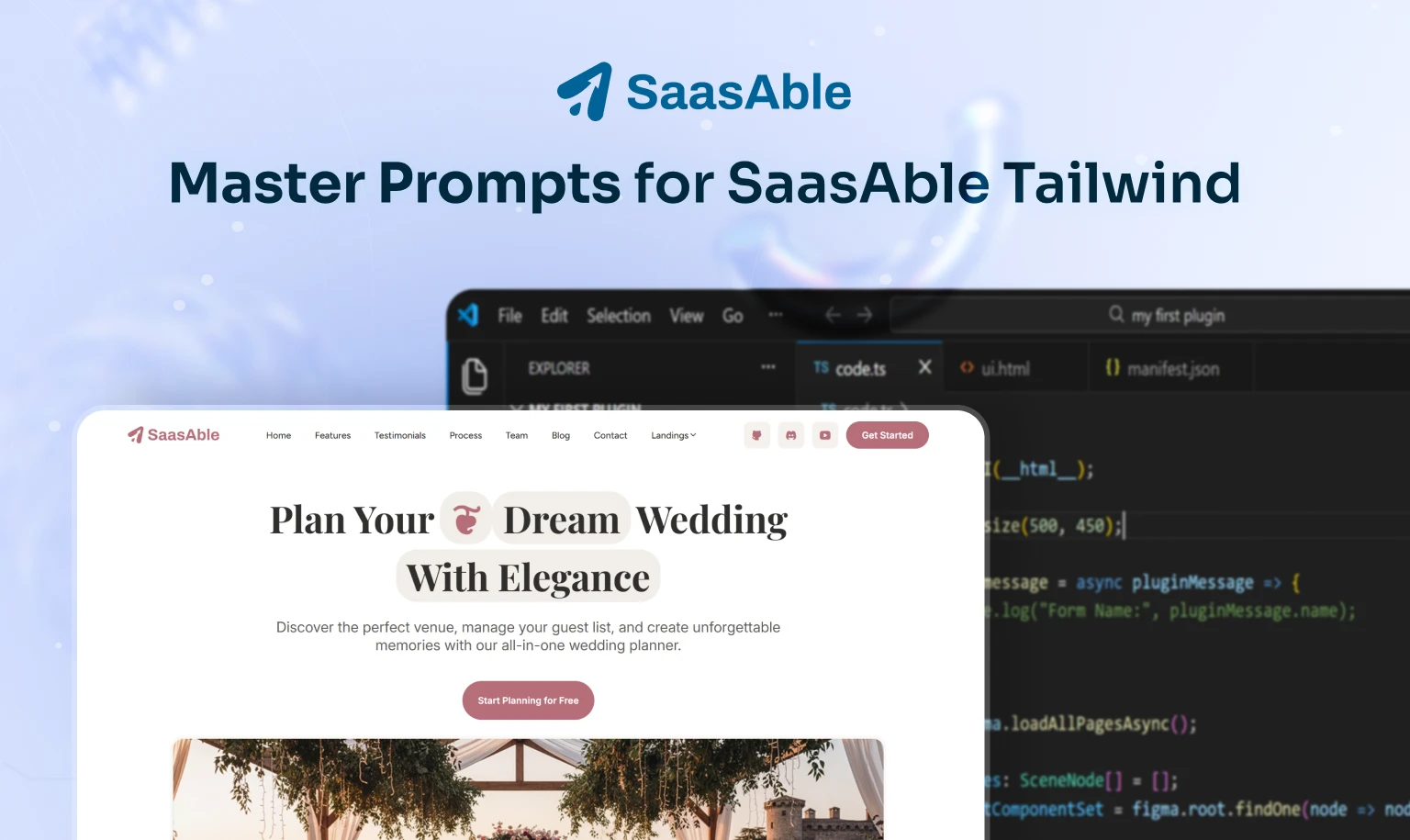

In 2026, building a SaaS product isn’t that complicated anymore.There are tools for everything that helps in deployment fast, generating UI with AI, delivering product or features quickly.
But once the product grows a bit, things start getting messy.
For Example:
- Layouts slowly become inconsistent.
- Components get duplicated instead of reused.
- Folders don’t feel as clean as they did on day one.
It doesn’t break immediately but becomes harder to manage over time. That’s usually where teams feel the pain.
SaasAble Tailwind was built from that experience.
It’s not just a Tailwind template with nice screens. It’s more like a starting structure for SaaS products, something that already thinks about dashboards, workflows, reuse, and long-term growth.
You’re not opening an empty project and figuring everything out yourself.
You’re starting with:
- A dashboard layout that already makes sense
- Components you can reuse without hacking around
- A folder structure that stays readable
- Landing layouts that don’t feel disconnected from the product
It’s like someone is building on top of something stable instead of constantly reorganizing what you built last month.
The real problem with AI landing page generators
SaasAble took care of the UI foundation. The dashboard stayed organized, and adding new features didn’t turn into a mess right away. That part actually worked well but still landing pages were still annoying. It’s not just because they were hard to generate, AI can give out a full page in seconds now.
The issue was… you’d look at it and think, “Okay, this is decent.” But it wasn’t something you’d confidently push live. You tweak the prompt, run it again, fix a few sections manually, and rewrite whatever still doesn’t feel right.
Then after a while, you realize you’re not really building faster. You’re just polishing AI output.
That’s when it clicked.
AI wasn’t the problem. It just didn’t have enough structure to work within!!!
What AI prompts mean in SaasAble Tailwind?
SaasAble AI prompts are not generic website prompts.
Inside SaasAble, AI prompts are not used to generate random or experimental websites. They are designed specifically for conversion-focused landing pages used in SaaS products, startup launches, and product marketing.
Unlike generic AI prompts, SaasAble prompts already understand landing page intent. The system knows which sections are required, which sections should be removed, and how content should flow to guide users toward action.
When a SaasAble prompt runs, it does more than generate text. It adjusts the message based on selected industry, applies a matching color system, and replaces basic placeholders with relevant images that fit your product.
Because structure and rules are predefined, layouts remain clean, predictable, and scalable. The output is not a demo or design concept, but a production-ready landing page optimized for real users and real conversion goals.
How agents.md gives AI full product context?
agents.md is a context file that helps AI tools understand how a product is built, not just what to generate. Instead of relying only on prompts, AI systems use agents.md to follow project-specific rules and structure.
In 2026, AI performs best when it has clear constraints. agents.md provides those constraints by defining how the project is organized, what patterns must be followed, and what should never be modified.
A typical agents.md file includes:
- Project architecture and folder structure
- Component boundaries and reuse rules
- Build and layout constraints
- Do and don’t guidelines
- Workflow and contribution expectations
With this context in place, AI stops guessing. It behaves more like a trained team member, producing consistent, safe output that respects the product’s structure and design system.
How SaasAble gives AI the right page structure?
Most AI tools generate landing pages the same way:
- You give a prompt
- It predicts what a landing page might look like
- Every generation is slightly different
That sounds flexible. But in real projects, it creates problems like:
- The section order changes
- The hero feels too long
- Features are unclear
- CTAs move around here and there
- Design spacing becomes inconsistent
When you regenerate, the structure shifts again.
This is why most AI-built landing pages feel unstable.
Works with any AI Tool or LLM!
AI tools change fast.
One month your team uses one model.
Next month you’re testing another.
Pricing changes. Features change. Output style changes.
That’s normal now.
SaasAble does not depend on one specific AI tool.
It works with whatever you already use.
You can generate content with:
- ChatGPT
- Claude
- Gemini
Or any coding agent inside your editor
SaasAble handles the structure.
The AI only fills in the content.
So even if you switch models tomorrow, your landing page system does not break.
From prompt to landing Page: How the workflow actually works?
SaasAble follows a structured workflow that turns a simple prompt into a fully functional landing page, without manual fixing or repeated regeneration. Each step exists to remove uncertainty and keep the output consistent.
Step 1: Industry Selection
You begin by selecting your business category. This step gives the system context about your audience, tone, and visual expectations, which influences content, layout, and design decisions later.
Step 2: Smart Plan Generation
SaasAble creates a landing page blueprint instead of jumping directly into code. This plan defines section order, content blocks, and conversion flow before anything is built.
Step 3: Review and Feedback
You review the proposed structure and either approve it or request changes. This step prevents rework by validating the direction early.
Step 4: File Structure Setup
Once approved, SaasAble generates a new landing page directory and connects the required components. This ensures the page follows the project’s architecture from the start.
Step 5: Content Customization
Text content is rewritten to match your industry, product type, and target audience. Generic placeholders are replaced with context-aware messaging.
Step 6: Color Presets Applied
Theme colors are adjusted to align with your niche and brand tone, keeping visual consistency across the page.
Step 7: Add Relevant Images
High-quality, relevant images replace default assets. Visuals are selected to match the product category and page intent.
Step 8: Default Page Setup
The newly created landing page is set as the active page, making it immediately usable without additional configuration.
Step 9: HTML Validation
Markup is validated and cleaned to ensure proper structure, accessibility, and compatibility with modern build tools.
Step 10: Build and Finalization
Theme presets are finalized and the project builds successfully, resulting in a production-ready landing page.
Why SaasAble Tailwind prompts work for any Industry?
When people hear “AI landing page prompts,” they assume the result will look generic. That usually happens when structure is weak. SaasAble works differently because it is built on modular Tailwind UI patterns not just random generation.
The thing is layout system stays the same and only the messaging changes. That’s why it works across industries like:
- Fintech
- Healthcare
- E-commerce
- AI startups
- B2B SaaS
The reason is simple: high-converting landing pages follow predictable UI patterns.
Why UI Kits matter more in an AI-first World?
AI gives speed and UI kits give consistency.
- AI generates ideas quickly
- UI kits keep layouts predictable
- Structure prevents redesign fatigue
In 2026, understanding framework structure matters more than memorizing CSS. SaasAble acts as guardrails for AI creativity.
What makes SaasAble Tailwind different?
In 2026, there are plenty of AI landing page generators. You type a prompt and get something that looks impressive in seconds. The preview looks polished. The layout feels modern. But when you actually try to use it for a real product, problems start to show. The messaging feels shallow. The sections don’t flow properly. It looks finished, but it doesn’t feel ready for real users.
SaasAble was built for teams building real SaaS products. Not for flashy demos. Not for screenshots. It focuses on structure first, so the page makes sense before it ever goes live. The goal isn’t to create something that just looks good but it’s to create something you can confidently launch, test, and grow around.
Closing Thoughts
AI makes it easy to move fast. You can turn an idea into a landing page in minutes. But without structure, that speed creates confusion. Sections don’t flow. Layouts feel inconsistent. You end up fixing more than building.
SaasAble keeps things clear from the start. It gives your AI output a solid foundation, so the page feels organized, consistent, and ready for real users. In 2026, speed is common. Building with clarity is what really makes the difference.




Comments