

AI code review tools are intelligent tools that scan your code and point out the problem within seconds. They assist developers to write cleaner, safer and more efficient code with minimum manual work.
Essentially, these tools are based on artificial intelligence that is applied to analyze, identify, and enhance the quality of the codes more quickly than the traditional manual review techniques.
Nowadays, development teams desire to work fast but not to lose quality. It is where AI-powered code review comes in with the benefit of automation, accuracy and consistency. This guide will make you realize what they are, how they operate, and the most suitable ones to choose in 2026.
What are AI code review tools?
The AI code review and developer tools market is expected to grow from ~$6.7 billion in 2024 to about ~$25.7 billion by 2030.
AI code review systems are software that processes code based on machine learning, natural language processing, and pattern recognition. They identify typical mistakes, propose their solutions, and contribute to the observance of the standards of coding without the necessity of continuous human controls.
Similar to how AI tools for content creation help writers generate text faster, these tools will assist the developers throughout the code-writing process, to detect one bug to make recommendations on how to improve the structure, security and performance.
Key features of AI code review tools
The AI code review tools are full of intelligent features that enable the easier, quicker, and more dependable process of coding. The most important ones are as follows:
1. Automated Error Detection
These tools immediately scan code in order to identify syntax errors, logic errors, redundant variables and typical bug patterns. They are real time thus they are alerted whenever you write them.
2. Suggestions for code quality smartness
AI offers not only the identification of issues but also suggestions on how to organize code in a better way. It proposes better readability, performance and maintainability, and allows developers to adhere to best practices without additional work.
3. Security check vulnerability tests
The current AI scanning tools are able to spot dangerous functions, unprotected APIs, dependency attacks, and possible attack areas. This pre-deployment is used to avert huge security concerns.
4. Style, formatting and standards enforcement
Visit your PEP8 team, Airbnb team, Google Style team or your own rules, AI will make sure that your whole codebase is consistent. It is automatic in checking naming conventions, indentation and formatting standards.
5. Life long learning and adaptation
AI tools understand your history of coding, approved propositions, and history of your repositories. With time, they are able to provide more accurate suggestions and get specific to your team workflow.
6. Extensive linkage into the repository
Not all tools analyze a file in isolation but instead analyze the whole repository to identify the presence of issues that are recurring, complexity hotspots, and code smells. This provides the teams with a view of the long-term code health.
Benefits of using AI code review tools
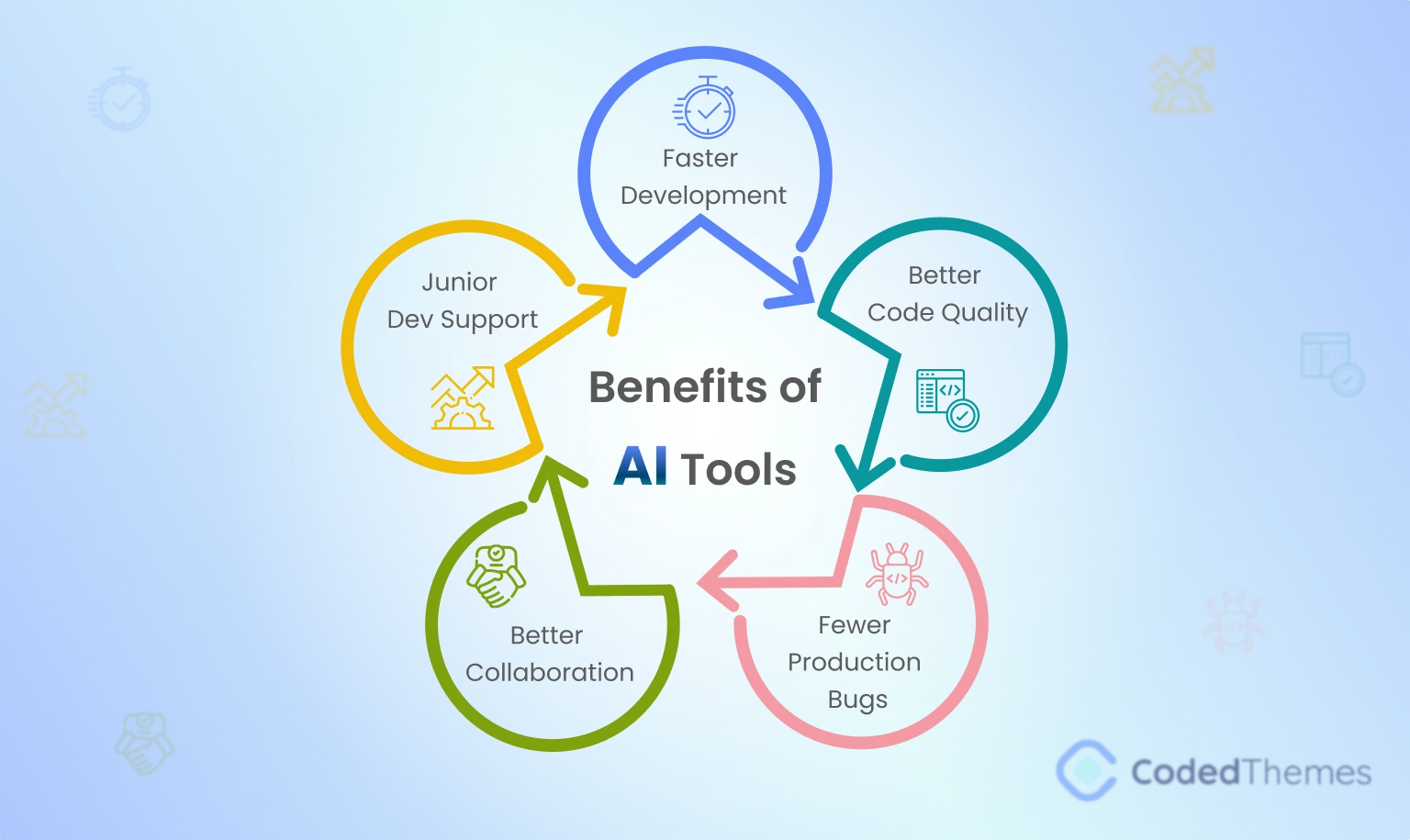
1. Faster development cycles
The AI saves time dedicated to the manual review. The developers are provided with immediate feedback and this enables them to correct the problems as they write the code.
2. Higher code quality
Regular scanning and recommendations result in cleaner and more trustworthy code by the teams.
3. Fewer bugs in production
AI tools are able to identify problems during the early phase and minimize the time spent on debugging and the risk of post-deployment problems.
4. Improved collaboration
Developers can also get actionable insights without having to wait until peer reviewers can also improve team workflow.
5. Junior developers support
These tools are similar to mentors, which assist new developers to comprehend standards and create more refined code.
Limitations of AI code review tools
Although AI technologies are quite strong, they also have their drawbacks:
1. No substitute to a full review
AI will be unable to recognize context-specific logic or project-specific requirements than humans do.
2. Occasional false positives
In some cases, tools raise concerns on things which are not considered problems and thus end up being corrected unnecessarily.
3. Dependence on training data
The suggestions provided by the underlying AI might also be less precise in case the underlying AI has not been trained on comparable code patterns.
4. Inadequate architectural knowledge
AI is concerned more with code level optimization, rather than architecture or clarity of business logic.
How AI code review tools work?
AI code review systems have a sequence of steps to follow:
1. Code Analysis
The system reads the code with the help of ML models that also have been trained with millions of code samples in different languages.
2. Pattern Recognition
It matches your code with the known bug patterns, best practices and the code standards.
3. Issue Identification
The tool identifies mistakes, weaknesses, and quality problems and proposes potential solutions.
5. Continuous Improvement
The tool learns as the developers approve or disapprove suggestions and the subsequent reviews are more intelligent.
Best AI code review tools
These are the best AI code review tools that you should look into in 2026. To learn more, go through the blog: Best AI Code Review Tools for 2026.
1. GitHub Copilot
GitHub Copilot helps in making code-suggestions, bug-detection, and intelligent auto-completion. It also interprets the intent of the developer and provides solutions immediately, simplifying and speeding up the process of coding.
2. DeepCode
DeepCode is a machine learning tool that is used to analyze codebases in real time and identify critical bugs. It analyses millions of open-source repositories, and offers very precise suggestions of fixes.
3. Codacy
Codacy checks the quality of code and detects and fixes security bugs, as well as maintains all-way consistency. It is multi-linguistic and it can seamlessly integrate with CI/CD pipelines.
4. Swimm
Swimm is concerned with code documentation and assists to keep the teams clear. It automatically generates, updates and synchronizes documentation with the changes in the code using AI.
5. AskCodi
AskCodi aids developers with the creation of code, examination of code snippets and provision of useful insights. It is particularly helpful when one wants to obtain immediate explanations and enhancements, and is a beginner.
Conclusion
The AI code review tools are revolutionizing software development by increasing the speed of analysis, accuracy, and ease of work. They assist teams to eliminate bugs, uphold quality and accelerate delivery. Although advanced logic requires human oversight, AI tools are being used as a reliable base of enhancing the scale of code.
With 2026 coming closer, using AI-powered reviewing tools is not an option anymore: it is a smart step toward efficient and modern development practices.
FAQs
Are AI code review systems superior to manual reviews?
They are not a substitute for manual reviews but complement them. AI is good to do fast checks, whereas humans are good at logic and context.
Are AI tools compatible with any programming languages?
Most of the tools have major language support, such as Python, JavaScript, Java, C++, and others, although not all.
Are AI tools used in code reviewing costly?
A lot of them are free, but their paid plans are necessary to have some premium features such as detailed security scan or team analytics.
Is AI capable of identifying security deficiencies?
Yes, numerous state-of-the-art tools are used to scan repositories on vulnerabilities and suggest secure coding practices.
Are AI code review tools beneficial in developer productivity?
Absolutely. They minimize repetitive work, offer immediate feedback, and assist teams in offering better code at a reduced speed.








Comments